
How API Integration Helps Different Business Systems Work Together
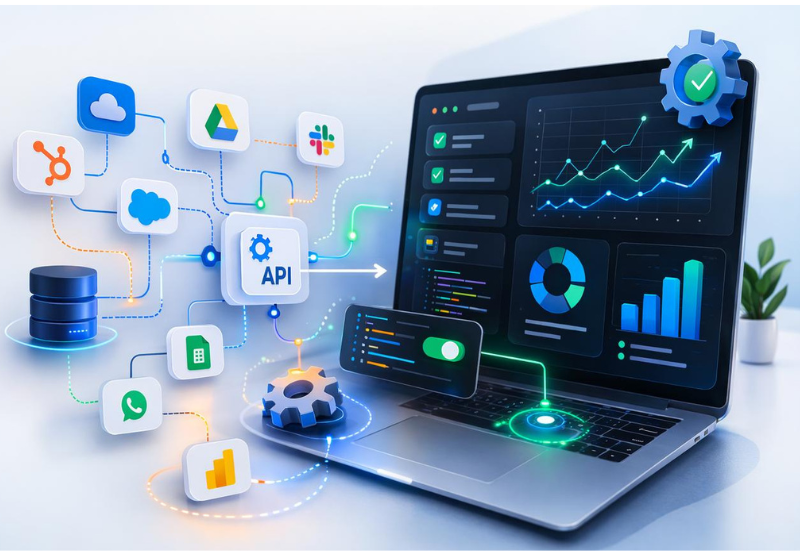
Modern businesses use different software applications to manage their daily activities. A company may use one platform for accounting, another for customer management, a separate application for online sales, and additional tools for communication and reporting.
Although each application may perform its job effectively, managing them separately can create unnecessary complications.
Employees may need to enter the same information into multiple systems. Customer records may become inconsistent, and important updates may take longer to reach the relevant departments.
This is where API integration becomes useful.
API integration allows different software applications to communicate and exchange information with each other. It helps businesses connect their digital systems and create more coordinated workflows.
In this article, we explore what API integration means, how it works, and why it is becoming important for businesses that depend on multiple software platforms.
What Is an API?
API stands for Application Programming Interface.
An API is a set of rules and mechanisms that allows different software applications to communicate and exchange information.
Think of a business that uses an online store and a separate inventory management system.
When a customer purchases a product, the online store needs to share order information with the inventory system.
An API can help transfer the required information between these applications.
In simple terms, an API acts as a communication bridge between software systems.
What Is API Integration?
API integration is the process of connecting two or more software applications through their APIs so that they can exchange data or perform specific actions.
Instead of operating as completely separate platforms, connected systems can share relevant information.
For example, an organization may integrate:
A website with a customer management system.
An online store with an inventory platform.
A payment gateway with an e-commerce application.
Accounting software with an invoicing system.
A mobile application with a business database.
A booking platform with a notification service.
The exact integration depends on the available APIs, technical requirements, security controls, and business objectives.
1. Reduces Repeated Data Entry
One common challenge in businesses is entering the same information into multiple applications.
For example, when a customer places an online order, employees may need to update order information manually in another system.
This process takes time and creates opportunities for mistakes.
With suitable API integration, information can be transferred automatically between connected applications.
Consequently, employees may spend less time entering duplicate information and more time handling important tasks.
2. Improves Data Accuracy and Consistency
When different departments maintain separate records, information may become inconsistent.
For example, the sales team may have updated customer contact details while the support team continues using older information.
API integration can help connected applications share updates and maintain more consistent records.
However, businesses must establish clear rules about which system is responsible for specific information.
Proper data validation and synchronization are also important to prevent duplicate or incorrect records.
3. Connects E-Commerce and Inventory Systems
Online businesses often need accurate inventory information to manage product availability.
If an online store and inventory platform operate separately, stock information may not update immediately after a purchase.
An integration can help share order and stock information between the systems.
For example, when an order is placed, the inventory platform may receive the relevant transaction details and update the available quantity.
This can help businesses manage product information more efficiently.
4. Simplifies Online Payment Processes
Businesses that accept digital payments often use external payment gateways.
API integration can connect a website or mobile application with a payment provider.
This allows the application to send payment requests and receive transaction responses through the provider’s supported integration process.
For example, after a customer completes a payment, the system may receive confirmation and update the order status.
Payment integrations must be implemented carefully. Businesses should follow the provider’s security requirements and avoid storing sensitive payment information unnecessarily.
5. Improves Customer Relationship Management
Customer Relationship Management (CRM) software helps businesses organize customer information, interactions, and sales activities.
When a website, enquiry form, or marketing platform is connected to a CRM system, relevant information can be transferred into the customer database.
For example, when a visitor submits an enquiry form, the integration may create a new lead record.
The sales team can then review the enquiry and manage the follow-up process.
This can make customer information easier to organize and access.
6. Supports Better Business Reporting
Business owners often need information from multiple departments to understand organizational performance.
However, preparing reports can become difficult when data is stored across disconnected platforms.
API integration can help collect information from different applications and make it available to reporting systems.
For example, a business dashboard may use data from sales, inventory, and accounting applications.
This can help management review relevant information without manually collecting every report.
The accuracy of these reports still depends on the quality, timing, and reliability of the connected data sources.
7. Improves Communication Between Business Applications
Businesses may use different tools for email communication, customer support, project management, and internal notifications.
Integrating these systems can help relevant information move between applications.
For example, when a customer submits a support request, the system may create a ticket and notify the assigned employee.
Similarly, a project management application may receive updates when a particular business activity is completed.
These integrations can support better coordination between teams.
8. Makes Business Systems More Flexible
Businesses do not always use the same software throughout their operations.
As requirements change, organizations may introduce new applications, replace outdated platforms, or expand existing systems.
API integration can make it easier to connect suitable applications without rebuilding every system from the beginning.
However, compatibility depends on the APIs, available features, authentication methods, and technical limitations of the applications involved.
Businesses should evaluate these factors before selecting an integration approach.
9. Supports Mobile and Web Applications
Modern businesses may provide services through both websites and mobile applications.
These platforms often need access to common information, such as customer accounts, product details, bookings, and order records.
APIs can allow applications to communicate with backend systems and retrieve the information they require.
For example, a mobile booking application may connect to a central database to display available appointments.
This helps businesses maintain connected digital experiences across different platforms.
10. Helps Businesses Prepare for Future Expansion
As organizations grow, they may introduce additional departments, applications, and digital services.
Managing every new system independently can become difficult.
A well-planned integration strategy can help businesses connect their applications as requirements expand.
For example, a growing retail business may eventually need to connect its online store, inventory system, accounting software, and customer management platform.
Planning integrations carefully can reduce unnecessary duplication and support more organized operations.
Common Examples of API Integration in Business
API integration can be used in several business situations.
| Business requirement | Possible integration |
|---|---|
| Online payments | Website and payment gateway |
| Customer enquiries | Website forms and CRM |
| Online shopping | E-commerce and inventory systems |
| Accounting | Sales platform and accounting software |
| Appointment booking | Booking application and notification service |
| Mobile applications | Mobile app and backend services |
| Reporting | Business applications and analytics platform |
These are examples of common integration possibilities. The actual implementation depends on the software providers and technical requirements.
Important Factors to Consider Before API Integration
Although API integration provides useful opportunities, businesses should plan the process carefully.
1. Identify Your Requirements
Understand which applications need to communicate and what information should be exchanged.
2. Check API Availability
Confirm that the software providers offer suitable APIs and that the required features are supported.
3. Review Security Requirements
Consider authentication, access permissions, encryption, and secure handling of business information.
4. Plan Data Validation
Define how information should be checked before it is transferred between systems.
5. Consider Error Handling
Integrations should account for failed requests, unavailable services, and incomplete transactions.
6. Test Before Launch
Test the integration with different scenarios to identify problems before using it in live business operations.
7. Plan Ongoing Monitoring
API integrations may require updates when connected applications change their features or API versions.
Regular monitoring helps identify problems and maintain reliable communication.
Common API Integration Challenges
Businesses should also understand the challenges that may arise during integration.
Compatibility issues: Different applications may use different data formats or authentication methods.
Security risks: Poorly managed API access can expose sensitive business information.
Rate limits: Some providers restrict the number of requests that can be made within a specific period.
Data synchronization problems: Incorrect synchronization rules can create duplicate or inconsistent records.
Third-party changes: Software providers may update or discontinue API features.
Maintenance requirements: Integrations need monitoring, troubleshooting, and updates over time.
Working with a structured development approach can help businesses prepare for these challenges.
Frequently Asked Questions
Q1. What is API integration in simple terms?
API integration connects different software applications so they can communicate and exchange information.
Q2. Why do businesses need API integration?
It can reduce repeated data entry, connect business applications, improve information sharing, and support more coordinated workflows.
Q3. Is API integration useful for small businesses?
Yes. Small businesses can use integrations to connect websites, payment services, accounting applications, customer management tools, and other software.
Q4. Is API integration secure?
It can be implemented securely when appropriate authentication, access permissions, encryption, and monitoring practices are used. Security depends on the design and maintenance of the integration.
Q5. Can a website connect to third-party software through an API?
Yes. If the website and third-party platform provide compatible APIs, they may be integrated to exchange supported information.
Q6. Does API integration require ongoing maintenance?
Yes. Integrations may need updates and monitoring when connected applications change their APIs, security requirements, or functionality.
Conclusion
API integration helps businesses connect different software applications and improve how information moves across their operations.
From online payments and customer management to inventory tracking and reporting, integrations can reduce manual work and support better coordination.
However, successful integration requires clear requirements, compatible systems, suitable security controls, careful testing, and ongoing maintenance.
Businesses should focus on connecting applications that provide genuine operational value rather than integrating systems without a clear purpose.
Looking to connect your business software and applications? Connect with Five Seven IT Solutions Pvt. Ltd. to explore software development and integration solutions aligned with your business requirements.